
Defining and Non-Defining Relative Clauses
The comma that changes meaning — who vs ,who,
Explanation
A relative clause is a small sentence that gives more information about a noun. There are two main types, and the comma tells you which one you are reading.
Defining relative clauses
These give information that is essential to understand the sentence. They answer the question "Which one?" We do not use commas.
Example: The neighbour who has a dog is friendly. — This tells us which neighbour (the one with the dog). Without the clause, the meaning is not clear.
Non-defining relative clauses
These give extra information about someone or something we already know. The sentence is complete without them. We put commas before and after the clause.
Example: My neighbour, who has a dog, is friendly. — We already know the neighbour; the dog is just an extra detail.
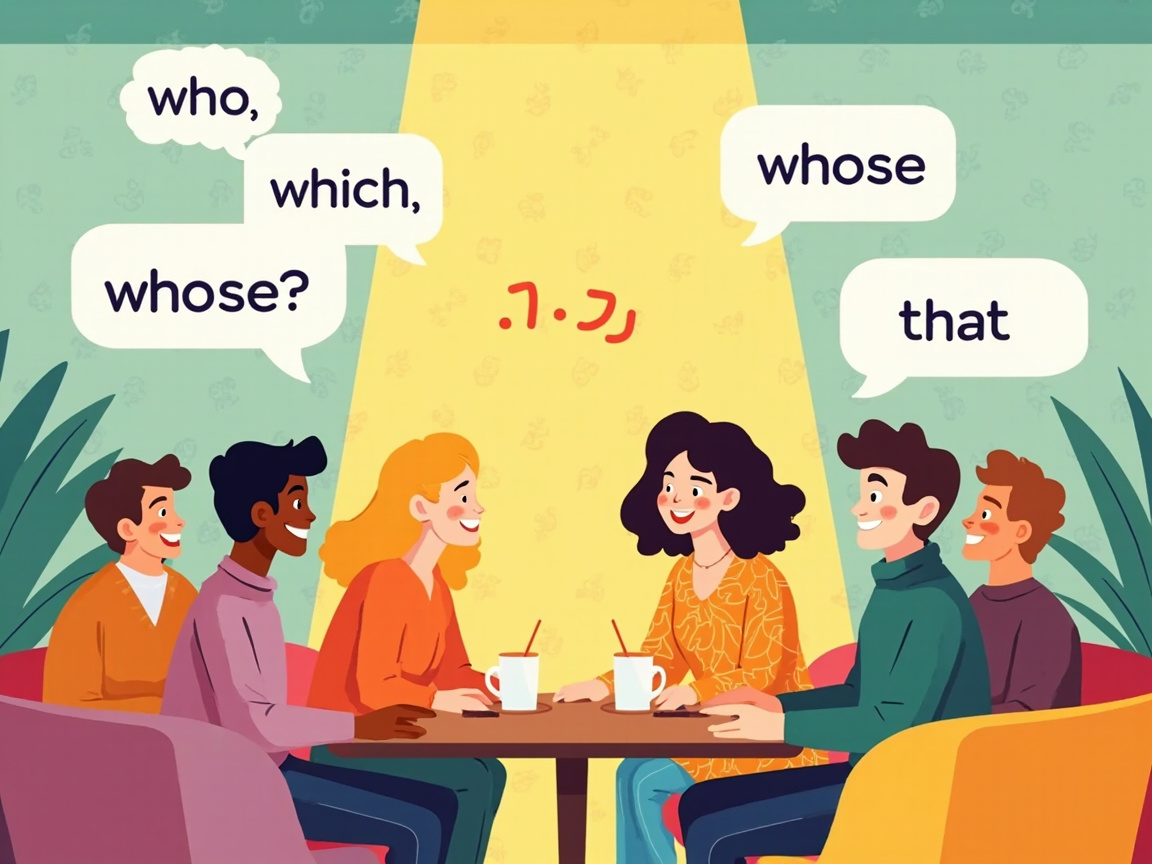
The pronouns
- who — for people
- which — for things
- whose — for possession (people and things)
- that — for people or things, but ONLY in defining clauses
Examples
Defining (no commas — essential):
- The student who won the prize is my sister.
- I bought the book that you recommended.
- The café which opens at 7 a.m. is on this street.
Non-defining (with commas — extra info):
- My sister, who is a doctor, lives in Paris.
- Paris, which is the capital of France, attracts millions of visitors.
- Mr. Brown, whose car is red, is our new teacher.
Notice how removing the non-defining clause still leaves a complete sentence: My sister lives in Paris. But removing the defining clause breaks the meaning.
Common mistakes
1. Using "that" in a non-defining clause.
❌ My sister, that lives in Paris, is visiting.
✓ My sister, who lives in Paris, is visiting.
Remember: that is only for defining clauses.
2. Forgetting the commas.
❌ My brother who is a teacher lives in London. (This suggests you have more than one brother.)
✓ My brother, who is a teacher, lives in London. (You have one brother.)
3. Using "what" instead of "which" or "that".
❌ The book what I read was great.
✓ The book which/that I read was great.
4. Adding commas to a defining clause.
❌ The students, who passed the test, will graduate. (This implies all the students passed.)
✓ The students who passed the test will graduate. (Only some of them passed.)
In real life
A short conversation between two friends, Anna and Ben.
Anna: I met your brother yesterday.
Ben: Which brother? I have two.
Anna: The one who works at the hospital.
Ben: Oh, Tom! Yes, he's very friendly.
Anna: And your sister, who studies in London, is she coming home soon?
Ben: Yes, she arrives next week. I'm so happy.
Anna: That's great. Your family, which is very close, must be excited.
Ben: Definitely!
اختبر نفسك
-
1What punctuation is required around a non-defining relative clause?
Non-defining relative clauses are set off by commas because the information is extra, not essential.
-
2In 'The book that I read was interesting', why is no comma used?
Defining clauses give essential information about which book is meant, so no commas are used.
-
3Which relative pronoun CANNOT be used in a non-defining clause?
'That' is used only in defining relative clauses, never in non-defining ones.
-
4In 'My mother, who is 60, still works', what does the relative clause do?
The commas show that 'who is 60' is extra information about a mother we already know.
-
5How is 'The students who passed the exam celebrated' different from 'My students, who passed the exam, celebrated'?
The first (defining) limits the celebration to some students; the second (non-defining) means all of my students passed and celebrated.