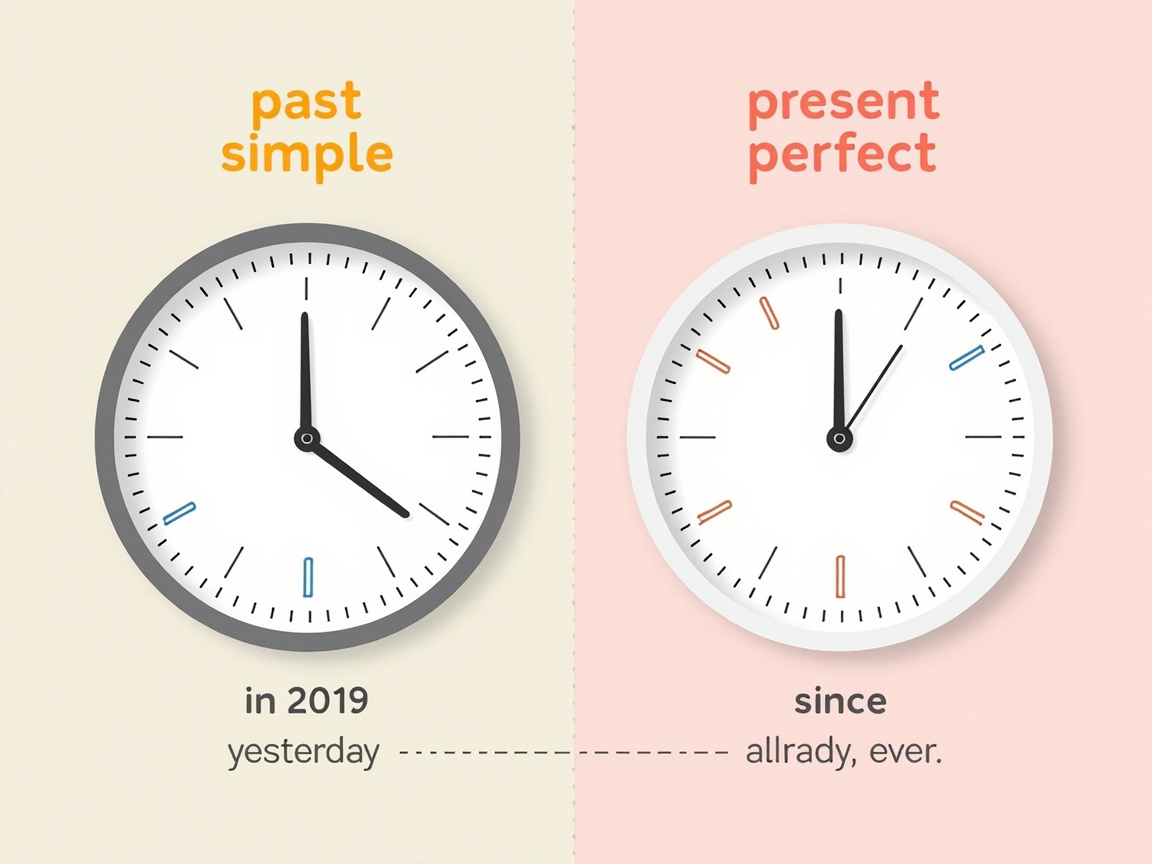
Present Perfect vs Past Simple
How to choose between 'I have been' and 'I went' — a clear, simple guide for B1 learners.
Explanation
English has two common past tenses, and choosing the right one is one of the biggest challenges for B1 learners. The good news? The choice is usually about time and connection to now.
Past Simple: finished and dated
Use the Past Simple for a completed action at a specific time in the past. The action is over, and the time is mentioned or clear.
- I visited Rome in 2019.
- She finished work at 6 p.m.
- They went to the cinema last night.
Present Perfect: connected to now
Use the Present Perfect when the past action has a result now, when you talk about life experience (no date), or when an action continues up to this moment.
- I have visited Rome three times. (life experience)
- She has lost her keys. (result: she can't find them now)
- We have lived here since 2015. (continues to now)

Quick signal words
Past Simple: yesterday, last week, in 2010, ago, when, on Monday.
Present Perfect: just, already, yet, ever, never, since, for, recently, so far.
Examples
Look at the pairs below. The meaning is similar, but the tense changes the message.
- I went to Japan in 2018. (specific trip, finished)
- I have been to Japan three times. (life experience)
- He lost his phone yesterday. (past story)
- He has lost his phone. (he can't find it now)
- She worked in Berlin for five years. (she doesn't work there now)
- She has worked in Berlin for five years. (she still works there now)
- Did you see the film? (past viewing, specific)
- Have you seen this film? (asking about experience)
Common mistakes
- ❌ I have been to Italy last summer. → ✅ I went to Italy last summer. (Last summer = specific past time)
- ❌ Did you ever eat sushi? → ✅ Have you ever eaten sushi? (Ever = life experience)
- ❌ I have seen him yesterday. → ✅ I saw him yesterday. (Yesterday = specific past time)
- ❌ When have you arrived? → ✅ When did you arrive? (When + specific moment = Past Simple)
- ❌ Since five years I live here. → ✅ I have lived here for five years. (A period up to now = Present Perfect)
- ❌ I have been there two hours ago. → ✅ I was there two hours ago. (Ago = specific past time)
In real life
A short dialog at a coffee shop.
Anna: Have you ever been to Portugal?
Leo: No, I haven't. But I'd love to go. When did you last travel abroad?
Anna: I went to Spain last summer.
Leo: How long did you stay?
Anna: I stayed for two weeks. It was amazing.
Leo: Have you been back since?
Anna: No, I haven't. I have been really busy at work this year.
اختبر نفسك
-
1When do we use the Past Simple?
The article says the Past Simple is for completed actions at a specific past time, like 'last summer' or 'in 2019'.
-
2Which sentence is correct?
'Last summer' is a specific past time, so we use the Past Simple ('went'), not the Present Perfect.
-
3Which signal word is typically used with the Present Perfect?
'Already' is listed in the article as a signal word for the Present Perfect; 'yesterday' and 'last week' go with the Past Simple.
-
4Complete the sentence: 'I have lived here ______ 2015.'
'Since' is used with a point in time (2015); 'for' is used with a period (e.g., for ten years), and 'ago' goes with the Past Simple.
-
5In the sentence 'She has lost her keys', what is the result NOW?
The article explains that 'She has lost her keys' means the result now is that she can't find them — this is why we use the Present Perfect.