
Mixed Conditionals: Past Meets Present
If I had studied, I'd be fluent now — when time zones collide in one sentence.
Explanation
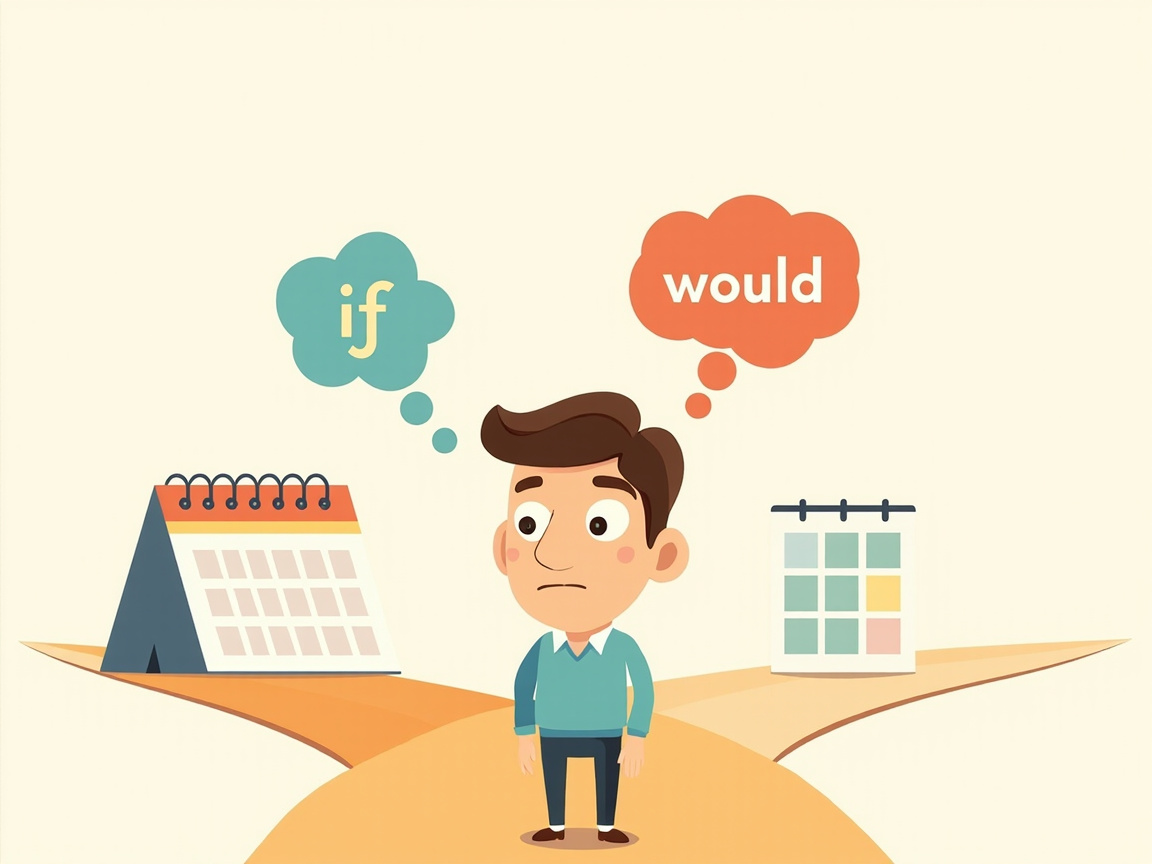
Mixed conditionals are powerful because they link two different time zones in a single sentence. They mix the form of one conditional with the meaning of another — the past with the present, or the present with the past.
Type A — Past condition, present result
The if-clause looks at an unreal past action; the main clause describes its present consequence.
- If-clause: past perfect (had + past participle)
- Main clause: would + base verb
If I had studied medicine, I would be a doctor now.
The studying didn't happen, so the job doesn't exist today.
Type B — Present condition, past result
The if-clause describes a current state; the main clause explains a past outcome that follows from it.
- If-clause: past simple (were / was)
- Main clause: would have + past participle
If she were braver, she would have told him the truth.
She's not brave now (a general truth), so she kept quiet yesterday.
The trick is to ask yourself two questions: When did the cause happen? and When is the effect visible? If the two times are different, you need a mixed conditional.
Examples
Read each sentence and notice how the two halves live in different time zones.
- If I had saved more money, I wouldn't be worried about prices today.
- If he had taken the job in Berlin, he wouldn't be living with his parents right now.
- If we were more punctual as a company, we wouldn't have lost the contract last year.
- If I didn't have such a sweet tooth, I would have eaten more healthily as a child.
- If your father were a bit more patient, he would have enjoyed the concert instead of complaining.
- If I had learned to cook at university, I would be saving a fortune on takeaways.
Notice how Type A uses had + past participle followed by would + base verb, while Type B uses past simple followed by would have + past participle. The two forms are never combined inside the same clause.
Common mistakes
- Putting the time zones in the wrong place. ❌ If I would have studied, I would be a doctor now. ✅ If I had studied, I would be a doctor now. The past cause goes in the if-clause; the present effect goes in the result clause.
- Using will in the main clause. Mixed conditionals are always hypothetical, so the modal must be would, never will. ❌ If I had known, I will call you. ✅ If I had known, I would call you.
- Mixing would have with had in the same clause. ❌ If I would have more time, I had gone to the gym. Choose one form for each half: If I had more time, I would have gone to the gym.
- Using was instead of were. In formal or hypothetical if-clauses with I/he/she/it, prefer the subjunctive were: If she were taller, she would have reached the shelf.
- Adding if to both halves. Only the first clause is the if-clause. ❌ If I had known if the train was late, I would have left earlier. ✅ If I had known the train was late, I would have left earlier.
In real life
A chat between two colleagues on Monday morning.
Anna: I can't believe I missed the deadline on Friday. I'm so annoyed with myself.
Ben: If you had started the report on Thursday, you wouldn't be panicking now.
Anna: I know. The problem is, if I were better at saying no to meetings, I would have finished it on time.
Ben: True. And honestly, if the manager had warned us earlier, we wouldn't be in this mess today.
Anna: If I were you, I would have complained to him months ago. You're too patient.
Ben: Maybe. But if I weren't so patient, I would have quit this job a long time ago — so it's a trade-off!
Quiz
-
1In a Type A mixed conditional, which tense is used in the if-clause?
Type A uses the past perfect in the if-clause because the unreal action is set in the past, even though the result is in the present.
-
2Which sentence correctly shows a present condition causing a past result?
This is Type B: 'were' (present state) + 'would have spotted' (past result), exactly the structure explained in the article.
-
3In the article's opening example, 'If I had studied, I'd be fluent now', why is 'would be' correct?
The result of the unreal past studying is visible in the present, so the main clause uses 'would + base verb' to describe that present state.
-
4Which of the following is flagged as a common mistake in the article?
The article warns that mixed conditionals are hypothetical, so the modal must always be 'would', never 'will'.
-
5In the dialog, Ben says: 'If the manager had warned us earlier, we wouldn't be in this mess today.' Which type of mixed conditional is this?
The if-clause uses 'had warned' (past perfect) and the main clause uses 'wouldn't be' (would + base verb), matching Type A exactly.